Legal work happens between documents
This kind of assignment shows how much legal work happens between documents. One amendment changes a deadline, another introduces an exception, and an email sent six months earlier may change how the entire relationship should be understood. The quality of the analysis depends on connecting that information and recognising what still needs to be checked.
This is where agentic AI becomes useful.
Agentic AI describes systems that can work towards a defined goal, use available tools, and adapt their next steps based on earlier findings. In legal work, this can mean connecting document searches, research, and drafting within a task that involves multiple steps.
For the user, the practical benefit is the ability to delegate more of the preparatory work. The user sets the objective, scope, and expected deliverable, while the system takes on part of the organisation and execution required to produce it.
Delegating the preparatory work
Returning to the supplier example, the instruction might look like this:
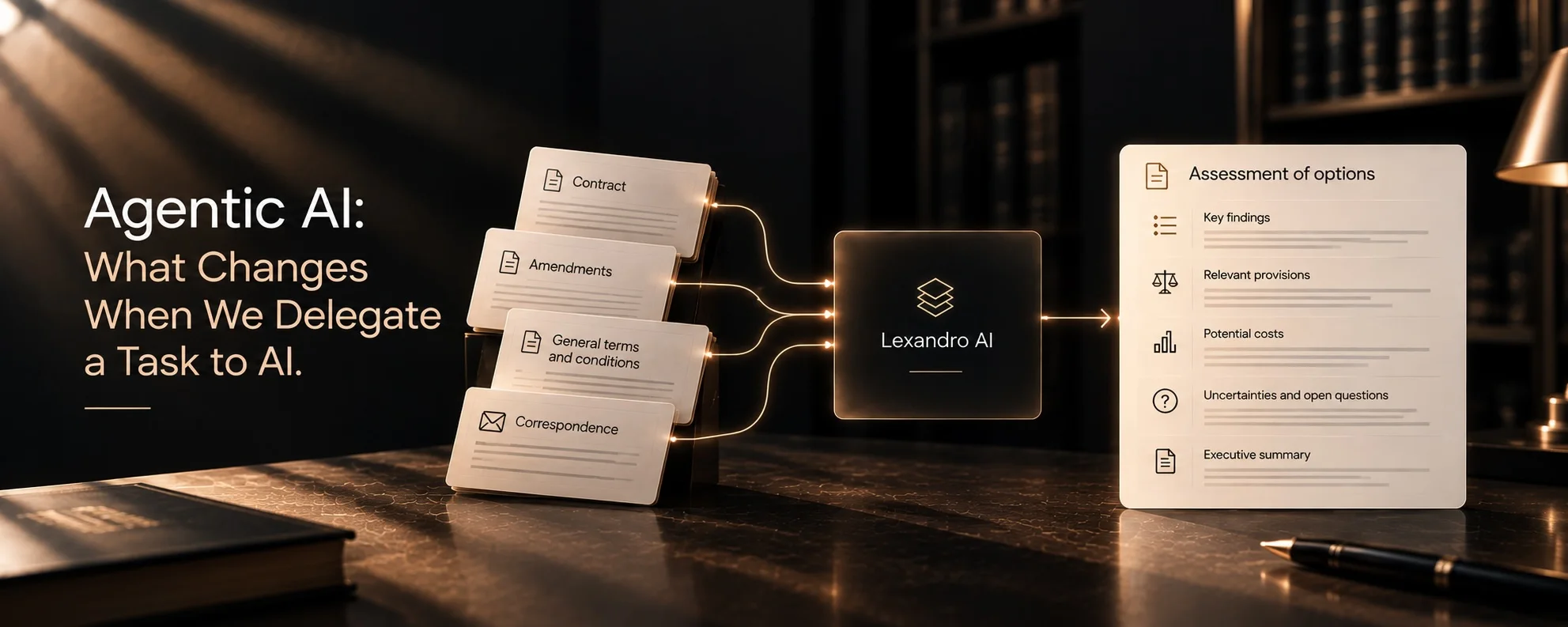
"Based on the attached documents, prepare an initial assessment of our options for ending the supplier relationship. Identify relevant provisions, deadlines, potential costs, and open questions. Cite the source for each finding and prepare an executive summary."
In a well-designed agentic process, the system would first establish which documents are available and how they relate to one another. It would then identify the relevant provisions, check whether the amendments change them, and research the legal questions arising from the circumstances.
If the contract refers to a missing schedule, that gap becomes a significant finding. If two provisions appear contradictory, they should be presented together and flagged for professional assessment. The result should help a lawyer quickly see what the documents establish, where uncertainty remains, and what requires further work.
Sometimes, the most useful finding is a precisely identified gap in the documentation. It tells the team what they need to obtain before making a decision.
Workflows, agents and orchestration
Technically, this process combines a language model, tools, and control logic. The model processes instructions and content, tools enable actions such as searching or retrieving documents, and control logic defines permitted actions and when the task should end. Coordinating these components is commonly called orchestration.
There is also a distinction between a predefined workflow and an adaptive agent. In a predefined workflow, the steps are set in advance. An agent can choose its next step within permitted boundaries based on what it finds. A reference to an amendment might trigger another search, while conflicting findings might require an additional check.
This flexibility is particularly useful when the scope of the work emerges during research. Extracting a date from a single document calls for a short process. Assessing a complex contractual relationship may uncover further questions with each new finding. The depth of the process should reflect the importance and complexity of the task.
Reviewability is the measure of value
For a legal team, the value of this approach depends on how easily the work can be reviewed. A significant conclusion should allow the reviewer to open the source, check the relevant passage, and understand the limitations of the analysis. A citation alone does not establish that the source supports the conclusion or applies to the matter.
Control therefore needs to be built into the working process: from the available documents and selected jurisdiction to reviewing drafts and approving actions with external consequences. Lawyers assess the legal reasoning, while the business decides which risks are acceptable in light of its objectives.
For management, the benefit can appear in the quality of the material it receives. A useful deliverable connects each option with its conditions, costs, and remaining uncertainties. That structure makes it easier for legal, finance, and operational teams to discuss the decision.
Success should be measured across the whole task. How long did it take to produce a reviewed assessment? How many substantive corrections were needed? Were unresolved issues identified early enough? A quickly generated draft creates value when it makes the team's subsequent work easier.
How this works in Lexandro
In Lexandro, the foundations for this approach include matter documents, selected legal sources, and the ability to inspect sources used in an answer. Workspaces keep documents and conversations in the context of a matter, while users choose which sources to include in their research. This brings internal documentation and legal sources into the same working environment.
Skills add another layer: saved instructions that let a team define its review methodology, risk criteria, and output structure. For example, a supplier contract review can consistently address liability, duration, termination conditions, and obligations that continue after the relationship ends. The team's experience takes a form that can be reused and refined over time.
A practical starting point
A practical starting point is one clearly defined, recurring task. Choose a familiar matter, specify the expected deliverable, and compare the analysis with your own professional assessment. Pay particular attention to how the system handles missing documents, exceptions, and conflicting information.
In the opening example, success would mean that by Monday, the lawyer has connected findings, clearly identified uncertainties, and a draft ready for review and refinement. Time previously spent assembling that foundation can be devoted to negotiations, business context, and the recommendation presented to management.